What is Plagiarism Check?
Last updated: October 23, 2026
Plagiarism is presenting someone else’s words or ideas as your own, without full credit.
Plagiarism Check compares your document with text that already exists: websites, scholarly articles, research papers, and books. GPTZero’s plagiarism checker draws on over 100 million of those sources. It shows how much of your text overlaps with them, which passages overlap, and where those passages came from.
What the similarity score means
The score shows how much your text matches existing sources and how many words match. AI detection is a separate scan, with its own score.
Some matches are the same words as the source. Others are close paraphrases, where the vocabulary, sentence structure, or phrasing follows another source closely. Matching passages are highlighted in your document, and each one is tied to its source.
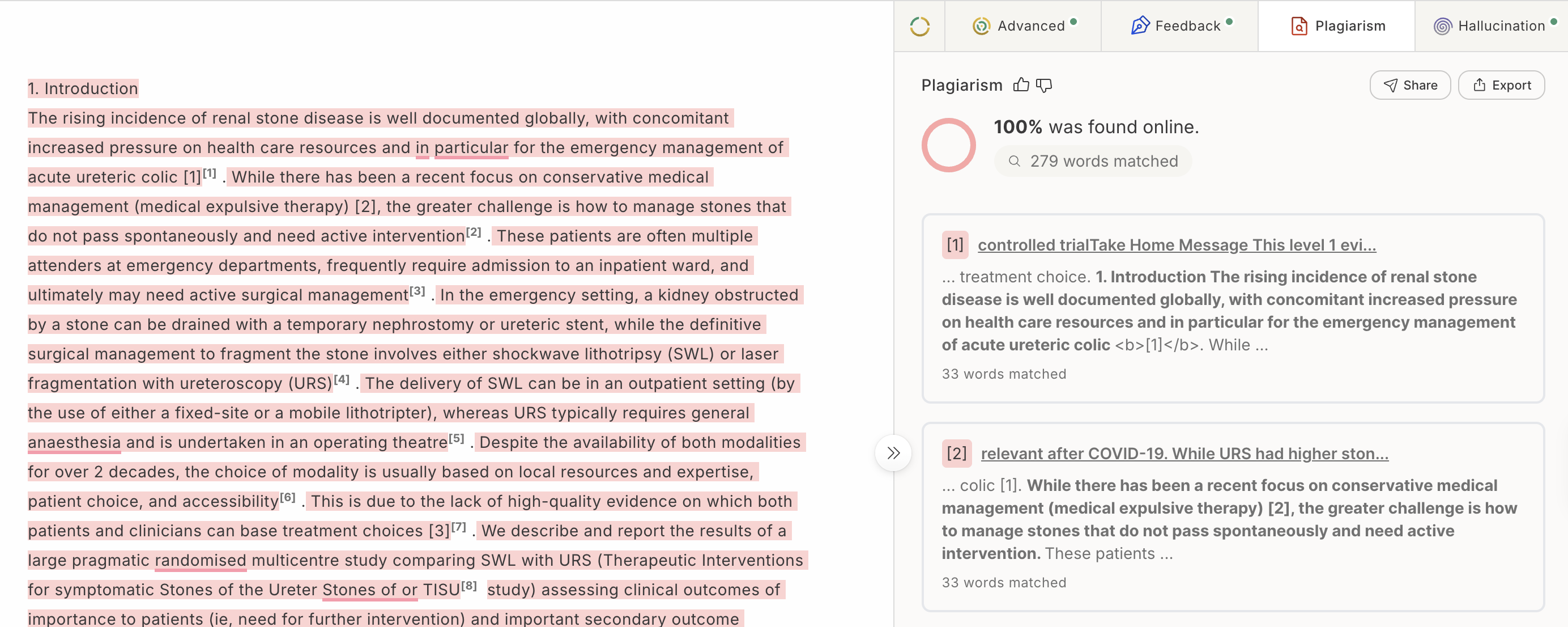
For each match, you get:
The source title, linked to the page or publication.
A short excerpt, with the matching words.
The publisher, when one is listed.
How many words matched that source.
Copy Citation, when a citation is available.
Select a match to jump to it in your document. Open the source and compare it with your passage. When the words or the idea came from there, quote them and cite them.
What a missing citation means
Overlap and missing credit are different. A passage can match a source and still be cited. A claim also needs a citation when you use your own wording.
Below the sources, the result lists claims that are not fully credited. A claim here is a sentence that states something a reader would expect to be sourced. There are two ways a citation can be missing:
Citation is missing in the bibliography. The sentence cites a source in the text, such as a name and year or a footnote, and that source is not in the bibliography.
Claim requires a citation. The sentence makes a strong claim and does not cite a source in the text.
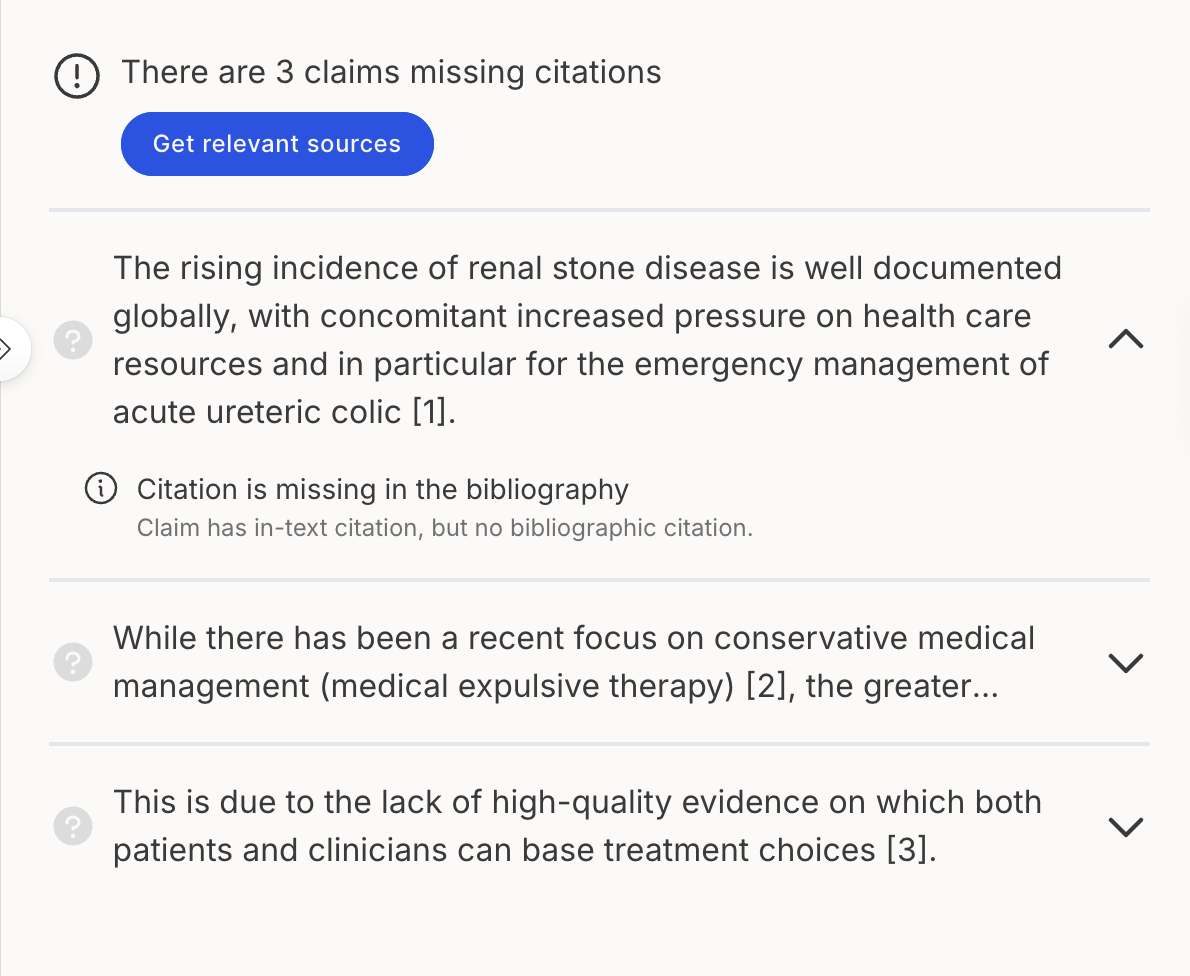
What relevant sources are
When claims are missing citations, Get relevant sources opens Hallucination and looks for sources for those claims. A relevant source is a page, article, or paper that relates to the claim. It may support the claim, debate it, or contradict it. You can read that source and cite it. The result does not decide that the claim is true or false.
How to run it
On the plagiarism checker page, paste your text or upload a file, then scan.
In the dashboard, enter your text, select Plagiarism Check, then click Scan. You can run it on its own or with other scans.
On a free account, selecting it asks you to upgrade before the check runs.